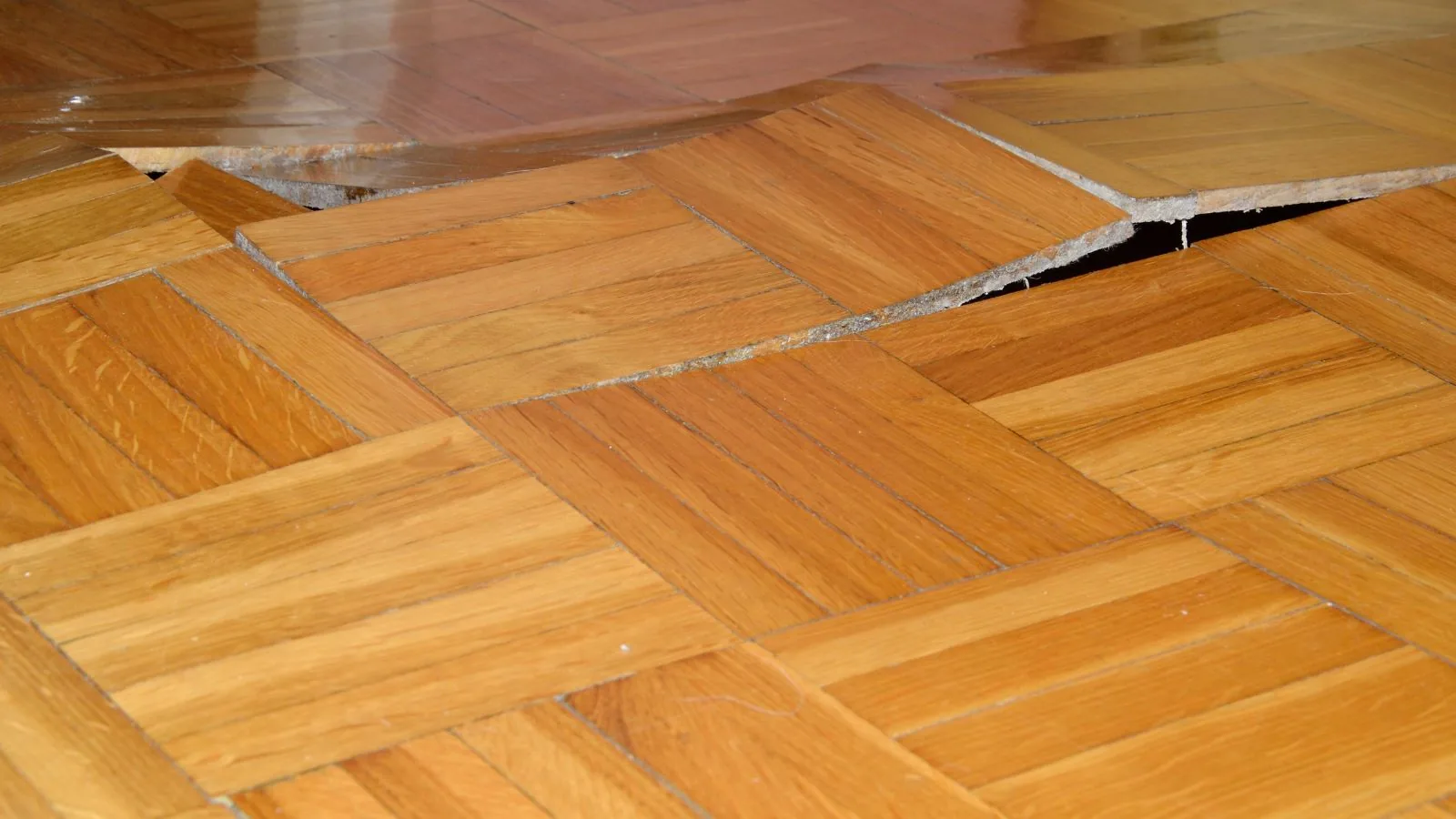
Wood floor water damage: what the signs mean
Cupping means the board edges are higher than the center, which happens when the bottom of the board absorbed more water than the top. Crowning is the opposite, and it can follow if a cupped floor is sanded before it dries. Buckling is when boards lift off the subfloor and is the most serious sign. Dark stains or black marks usually mean water has been there a long time.
Laminate behaves differently. Its fiberboard core swells at the seams and the edges lift, and once swollen it generally does not shrink back. If you see any of these signs, do not sand or refinish yet. Sanding a damp floor traps moisture and can ruin it.
How water gets under a floor
Water reaches a floor in three ways. It spills from above, such as an appliance or a tub leak. It rises from below through a slab or a damp crawl space. Or it enters at the walls and runs under baseboards. In each case the boards can be wet underneath long before the surface looks damaged.
That is why we test with a moisture meter and look at the subfloor. A floor that looks fine can still read high. If water came from below, a vapor problem may keep returning until the source is fixed, which we discuss on our crawl space and slab leak pages.
Drying a hardwood floor: when it works and when it does not
If we get to a wet floor within a day or two, drying mats, air movers and a dehumidifier can pull water out of the boards and subfloor, and many floors flatten back with little or no refinishing. The longer the water stays, the lower the odds. Wet floors that sat for more than a few days often have to be removed in sections.
Engineered hardwood can be harder to save than solid wood, because the glue between layers can fail. We tell you what the readings say and let you decide. For general drying principles, see structural drying.
Hardwood floor wet or cupping?
Call and we can take moisture readings. The line is open 24 hours.
Floor type and what to expect
| Floor type | Typical response to water | Can it be saved? |
|---|---|---|
| Solid hardwood | Cupping, then buckling if wet for long | Often, if dried quickly |
| Engineered hardwood | Edge lifting, layer separation | Sometimes, depends on the glue and the wear layer |
| Laminate | Swelling at seams | Rarely once swollen |
| Parquet | Tiles lift or pop | Sometimes, tile by tile |
What affects the cost
Wood floors vary by species and finish, so the scope sets the price.
- Floor material. Solid wood is more likely to be dried and kept than laminate
- Area wet. A single room costs less than a whole floor
- Time since the water. Quick action saves more floor
- Drying system. Mats and dehumidifiers run for several days
- Replacement or refinishing. Sanding and refinishing are separate from drying
Call (603) 550-7813 to arrange readings.
Insurance and hardwood floor water damage
A sudden appliance or pipe failure often triggers coverage for flooring, while a slow leak may not. Ask your insurer how yours reads. Readings and photos show how far the moisture traveled, and we leave the coverage question to your policy.
Hardwood Floor Water Damage questions, answered
Is a wet wood floor worth a late-night call?
When water is still spreading, yes, because boards start to absorb it immediately. The line is open 24 hours a day. Dispatch works toward same-day response and avoids quoting arrival times.
Will a cupped floor flatten out on its own?
Sometimes, if it dries slowly and fully. Do not sand until the readings are normal. A moisture meter tells you if it is ready.
Can I just replace the damaged boards?
Often yes for a localized loss. Matching the finish and stain can take care. We point out the wet boards and what the subfloor reads.
Should I turn on fans and heat myself?
A fan helps surface drying but does not dry a subfloor. Ask us before using heat, because very fast drying can split boards.
Call (603) 550-7813 about hardwood floor water damage.