Walls still damp or floors still wet after the leak stopped?
That is what structural drying is for. When water has been mopped up but a wall still feels cool, a baseboard is soft or the air smells musty, moisture is still inside the materials. A controlled drying setup with air movers and dehumidifiers pulls it out, and moisture readings show when it is finished.
What structural drying means in practice
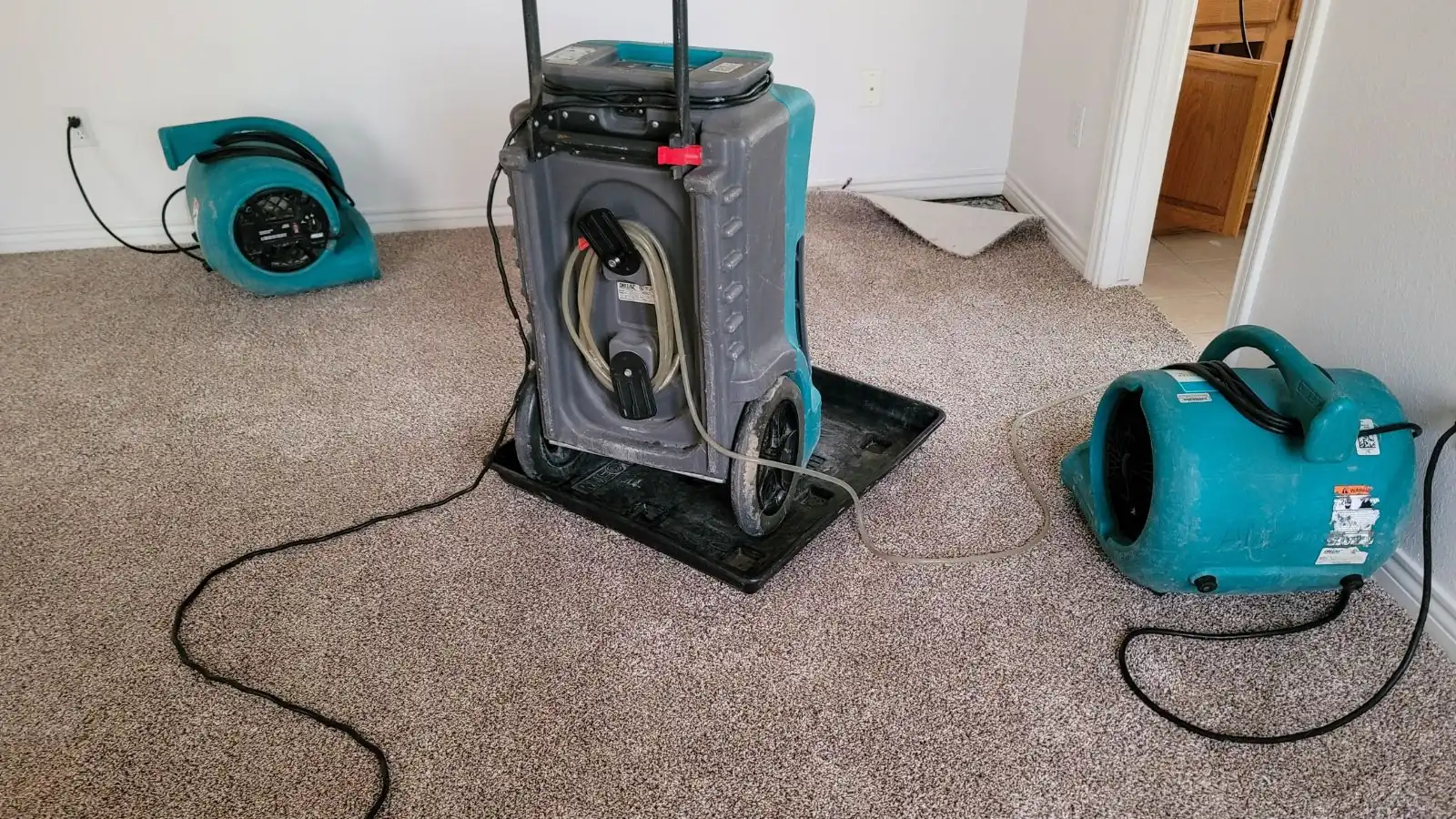
Drying is not just running fans. Air movers push dry air across wet surfaces to release moisture, and dehumidifiers pull that moisture out of the air. Without a dehumidifier, the water just moves from the wall to the air and then back into the wall. A room with fans and no dehumidifier can feel drier while the framing stays wet.
Professional drying also uses water mitigation as a term for the early steps that limit damage, such as extraction, removing unsalvageable materials and starting equipment. The faster that happens, the less material has to be replaced. The ANSI/IICRC S500 standard is the published guide for these practices, and a company that follows it will say so when asked.
Moisture mapping: how we know where the water is
We start by measuring. A pin or pinless moisture meter reads moisture content in wood and drywall, and a thermal camera shows cool spots where water is evaporating behind surfaces. We mark the wet boundary and record readings so there is a baseline. Then we check the same spots at each visit.
That record serves two purposes. It tells us when drying is done, and it gives you documentation for your insurer. If a wall reads high on day three, we keep drying or open it. If it reads back to a normal range, we remove the equipment.
Need drying equipment set up?
Call and describe what got wet. We answer 24 hours a day.
Equipment we use and what each does
| Equipment | What it does | Where it fits |
|---|---|---|
| Air movers | Push air across wet surfaces to speed evaporation | Floors, baseboards, lower walls |
| LGR dehumidifiers | Pull moisture out of air in damp, cool spaces | Whole rooms and enclosed spaces |
| Moisture meters | Read moisture in wood, drywall and subfloor | Mapping and daily checks |
| Thermal camera | Shows cool wet areas behind surfaces | Finding hidden water |
| Injection or drying mats | Dry wall cavities and hardwood floors | Materials that can be saved |
How long drying takes and what changes it
Drying usually takes several days. The range depends on how wet the materials got, what they are made of, the temperature and humidity, and how quickly water was removed. Dense materials such as hardwood, plaster and concrete take longer, and a closed-up cold basement dries slower than a warm room. Keene winters can push indoor humidity down, but cold spaces such as unheated additions and crawl spaces slow the process.
We visit to check readings, adjust equipment and move air movers. If readings do not drop on schedule, we investigate: there may still be a source, trapped water or a material that should be removed instead. Our pages on crawl spaces, carpet and walls and drywall describe how each material behaves.
What affects the cost
Drying is priced by equipment, time and labor, and we explain it before starting.
- Number of rooms and area. More wet area needs more air movers and dehumidifiers
- Days of drying. Equipment is charged by the day, and readings decide when it stops
- Materials. Dense materials need longer drying than drywall or carpet
- Monitoring visits. Daily checks with a meter add labor but prevent over-drying or early removal
- Access and conditions. Cold spaces and tight attics slow work
Call (603) 550-7813 and we will price drying for your layout.
Insurance and structural drying
Insurers often ask for proof that drying was needed and finished, and moisture logs plus photos supply it. Coverage depends on the cause of the water and your policy, so check it or ask your insurer. We make no promises on that side.
Structural Drying questions, answered
Is drying equipment set up on weekends too?
If water is active or a loss just happened, yes. Our line is open 24 hours a day. We respond the same day when we can, and we avoid quoting an arrival time we cannot keep.
Can I rent air movers and dehumidifiers and do it myself?
You can, but proper drying needs readings and placement. Without a meter you cannot tell when it is done. We will explain what we would do so you can decide.
How loud is drying equipment and how long does it run?
It is noticeable, similar to a box fan, and it usually runs for several days. We will tell you what to expect when we set it up.
How do I know the building is dry?
Moisture readings come back to a normal range for each material and match nearby dry areas. We record them so there is proof, not just a feeling.
Call (603) 550-7813 about structural drying.